Artificial intelligence (AI) is becoming an important part of everyday life. From AI chatbots and image generators to recommendation systems, search engines, and autonomous technologies, AI requires powerful computer systems to process enormous amounts of information.
But there is a lesser-known side of AI that many people don’t think about: water consumption.
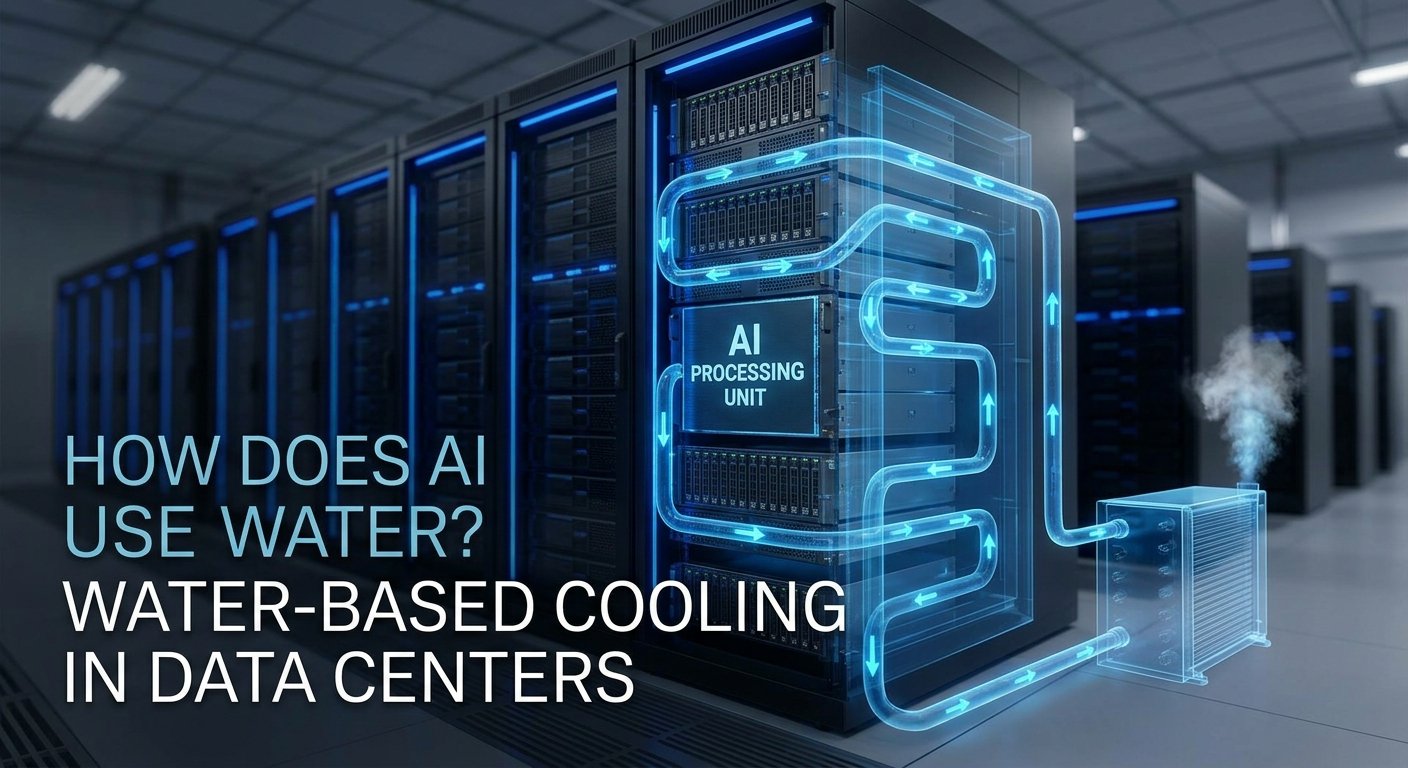
When you ask an AI chatbot a question, generate an image, or use an AI-powered application, powerful servers inside data centers process your request. These machines produce heat and need to be cooled. In many data centers, water plays an important role in the cooling process.
So, how does AI use water? How much water does AI consume? Why do data centers need water? And can AI become more water-efficient?
What Is the Connection Between AI and Water?
AI itself does not directly “drink” water. Instead, the computers and data centers that operate AI systems can require water for cooling.
AI models are usually trained and operated on powerful computing hardware such as GPUs and other specialized processors. These chips perform billions or even trillions of calculations, which generates significant amounts of heat.
If this heat is not removed, computer equipment can become too hot and potentially fail.
Data centers therefore use different cooling technologies to maintain safe operating temperatures. Some systems rely primarily on air cooling, while others use water-based cooling or a combination of methods.
This creates an indirect relationship:
AI → Powerful computers → Heat → Cooling systems → Potential water consumption
Why Do AI Data Centers Need So Much Cooling?
Training modern AI models can require thousands of high-performance processors running continuously for long periods.
These processors consume electricity, and much of that electrical energy eventually becomes heat.
For example, when an AI model is being trained, servers may operate under heavy workloads around the clock. The more computing power a data center uses, the more heat it generally has to manage.
Cooling systems help:
- Remove heat from servers
- Maintain stable temperatures
- Protect expensive hardware
- Prevent overheating
- Improve system reliability
- Keep AI services running continuously
Water can be an efficient way to transfer heat, which is why some data centers use it as part of their cooling infrastructure.
How Do Data Centers Use Water?
There are several ways water can be involved in data center operations.
1. Evaporative Cooling
One of the most common methods is evaporative cooling.
In this approach, water absorbs heat and some of it evaporates. The evaporation process removes heat from the system, helping lower temperatures.
This method can be energy-efficient, but it consumes water because some of the water leaves the cooling system as vapor.
2. Cooling Towers
Some large data centers use cooling towers.
Warm water is circulated through the cooling system and transferred to a cooling tower, where heat is released. A portion of the water may evaporate during the process.
Fresh water is then added to replace water lost through evaporation and other processes.
3. Chilled-Water Systems
Some facilities use chilled-water systems to transport heat away from servers.
Water is cooled and circulated through a building’s cooling infrastructure. Depending on the system design, water may be reused multiple times.
4. Liquid Cooling
Modern AI hardware can generate substantial amounts of heat, making liquid cooling increasingly interesting.
Instead of relying entirely on air, liquid can be brought closer to the heat-producing components.
Liquid cooling can potentially improve thermal efficiency and reduce the amount of energy required for cooling.
However, the overall environmental impact depends on the design of the system and how the facility manages its water and electricity use.
Does Every AI Query Use Water?
Not necessarily.
It would be inaccurate to say that every individual AI question uses a fixed amount of water.
Water consumption depends on many factors, including:
- The AI model being used
- The complexity of the request
- The hardware running the model
- Data center location
- Cooling technology
- Weather conditions
- Electricity source
- Data center efficiency
- Whether water is recycled
- Whether the calculation is measuring direct or indirect water use
This is why you may see different estimates for the water footprint of AI.
A simple text request and a large AI model generating high-resolution images or videos can require very different amounts of computing power.
AI Training vs. AI Inference
It is also important to understand the difference between AI training and AI inference.
AI Training
Training is the process of teaching an AI model using large quantities of data.
Training a large model can require enormous computational resources. Thousands of processors may operate for extended periods.
As a result, training can create substantial electricity demand and associated cooling requirements.
AI Inference
Inference happens when a trained AI model responds to a user.
For example, when you ask an AI chatbot a question, the model performs inference to generate an answer.
Individual inference requests are generally much smaller than training runs, but billions of AI interactions can add up.
The growing popularity of AI means that inference workloads are becoming increasingly important when considering the technology’s environmental footprint.
How Much Water Does AI Use?
There is no single number that accurately represents how much water AI uses.
You may encounter claims suggesting that a particular number of AI prompts corresponds to a bottle or glass of water. These estimates can be useful for illustrating the concept, but they should not be treated as a universal rule.
Why?
Because the water footprint can vary significantly between data centers and AI workloads.
For example, a data center operating in a cool climate may require less cooling than one operating in a hot climate. Similarly, a facility using recycled water can have a very different freshwater footprint from one relying heavily on potable water.
Therefore, instead of asking:
“How much water does one AI question use?”
a better question is:
“How much water is required to operate the computing infrastructure behind AI?”
That broader question provides a more meaningful picture.
Where Does AI’s Water Footprint Come From?
AI’s water footprint can be divided into different categories.
Direct Water Consumption
This is water used directly by data center cooling systems.
Evaporation is one example.
Indirect Water Consumption
AI also requires electricity.
Depending on how electricity is generated, producing that electricity may require water. Thermal power plants, for example, can use water for cooling.
Therefore, the environmental footprint of AI is not limited to the water physically used inside a data center.
Hardware Manufacturing
There is another part of the story: manufacturing computer chips.
Semiconductor manufacturing uses highly purified water during different stages of production.
AI hardware such as GPUs and specialized processors requires sophisticated semiconductor manufacturing processes.
Therefore, the broader water footprint of AI can include:
Data center cooling + electricity generation + semiconductor manufacturing
This is why researchers often distinguish between different definitions of water consumption.
Why Is AI’s Water Consumption Becoming a Concern?
AI adoption is growing rapidly.
Companies are building increasingly powerful AI systems, and data centers are expanding to support them.
At the same time, some data centers are located in areas where water resources are already under pressure.
This creates an important environmental question:
How can society expand AI infrastructure without placing unnecessary pressure on freshwater resources?
Water is essential for households, agriculture, ecosystems, and industry. In regions experiencing drought or water shortages, large industrial water demands can become particularly sensitive.
AI and Water Consumption Compared With Other Industries
It is important not to view AI’s water consumption in isolation.
Agriculture, electricity generation, manufacturing, mining, and many other industries can have enormous water footprints.
AI is only one part of the global water-use picture.
However, AI deserves attention because its infrastructure is expanding quickly.
As demand for AI services grows, researchers, governments, and technology companies are increasingly interested in measuring and reducing the environmental impact of data centers.
Can AI Data Centers Reuse Water?
Yes.
Water recycling and reuse can help reduce freshwater demand.
Instead of constantly using new freshwater, a facility can treat and circulate water through cooling systems.
Different approaches may include:
- Recycling cooling water
- Using treated wastewater
- Collecting rainwater
- Using closed-loop cooling systems
- Improving cooling efficiency
- Reducing evaporation losses
The feasibility of these approaches depends on local infrastructure, climate, water quality, regulations, and data center design.
Can Data Centers Operate Without Water?
Some data centers can use cooling approaches that require little or no water for certain cooling operations.
For example, air-based cooling systems can reduce direct water consumption.
However, avoiding water use entirely can involve trade-offs.
A cooling system that uses less water may consume more electricity in some circumstances. Therefore, the goal is not always simply to eliminate water use.
Instead, companies need to consider the overall environmental impact of:
Water + electricity + emissions + local environmental conditions
How Technology Companies Are Trying to Reduce Water Use
As AI infrastructure expands, companies are exploring different ways to improve data center efficiency.
Some strategies include:
More Efficient AI Models
Smaller and more efficient models can perform certain tasks using fewer computational resources.
Less computation can potentially mean less electricity and cooling demand.
Better Hardware
New generations of processors can deliver more computing performance per unit of energy.
Improved energy efficiency can reduce the amount of heat produced for a particular workload.
Advanced Cooling
Liquid cooling and other advanced technologies can help manage heat more efficiently.
Recycled Water
Using reclaimed or recycled water can reduce dependence on freshwater supplies.
Better Data Center Locations
Building facilities in climates that naturally support cooling can reduce cooling requirements.
Renewable Energy
Using low-carbon electricity can reduce AI’s greenhouse-gas footprint, although renewable energy does not automatically eliminate water consumption.
Does Using AI Affect the Environment?
Yes, AI can have several environmental impacts.
Its footprint can include:
- Electricity consumption
- Water consumption
- Carbon emissions
- Hardware manufacturing
- Mining of raw materials
- Electronic waste
- Construction of data centers
However, AI can also potentially help reduce environmental impacts in other industries.
For example, AI may be used for:
- Weather forecasting
- Energy optimization
- Water management
- Agricultural efficiency
- Climate research
- Wildlife monitoring
- Smart-grid management
Therefore, the environmental impact of AI is complicated. AI can create environmental costs while also providing tools that may help address environmental challenges.
Can AI Help Save Water?
Interestingly, AI can also be used to reduce water waste.
For example, AI-powered systems can analyze data from sensors to identify leaks in water networks.
Farmers can use AI to estimate irrigation requirements and avoid unnecessary watering.
Cities can use predictive systems to improve water distribution and detect unusual consumption patterns.
AI can also help researchers model droughts, rainfall, groundwater systems, and climate patterns.
So AI isn’t simply a consumer of water—it can potentially become a tool for better water management.
What Can Be Done to Reduce AI’s Water Footprint?
Reducing AI’s water footprint will likely require cooperation between technology companies, governments, researchers, and communities.
Some important solutions include:
- Use water-efficient cooling systems
- Increase water recycling and reuse
- Improve AI model efficiency
- Develop more energy-efficient processors
- Build data centers where environmental conditions are favorable
- Use non-potable or reclaimed water where appropriate
- Improve transparency around water consumption
- Measure both local and global environmental impacts
The most effective solution may differ from one location to another.
Frequently Asked Questions About How Does AI Use Water
How does AI use water?
AI models do not use water directly. Instead, the high-performance hardware running AI workloads in data centers generates intense heat, requiring water-based cooling systems, evaporative cooling, or chilled-water loops to regulate temperatures.
Why does AI need water?
AI requires powerful computers, and those computers generate heat. Water can be used in cooling systems to remove this heat and maintain safe operating temperatures.
Does generating AI images use more resources?
AI image generation can require more computational processing than some simple text requests. The exact resource and water footprint depends on the model, hardware, data center, and cooling system.
Is AI bad for the environment?
AI has environmental costs, including energy and potentially water consumption. However, AI can also help optimize energy, agriculture, water systems, scientific research, and other processes.
Its overall impact depends on how the technology is developed and used.
Can AI become more water-efficient?
Yes. More efficient models, better hardware, improved cooling technologies, recycled water, and smarter data center designs can all help reduce water consumption.
Final Thoughts
So, how does AI use water?
AI does not directly consume water when you type a question or generate an image. Instead, the computing infrastructure behind AI can use water, particularly for cooling powerful servers. Water can also be associated with electricity production and semiconductor manufacturing.
As AI becomes more powerful and widespread, understanding its water footprint will become increasingly important.
The good news is that companies can reduce this impact through water recycling, efficient cooling, improved hardware, smaller AI models, better data center designs, and responsible resource management.
The future of AI isn’t only about creating smarter machines. It is also about creating more efficient and environmentally responsible AI infrastructure.